
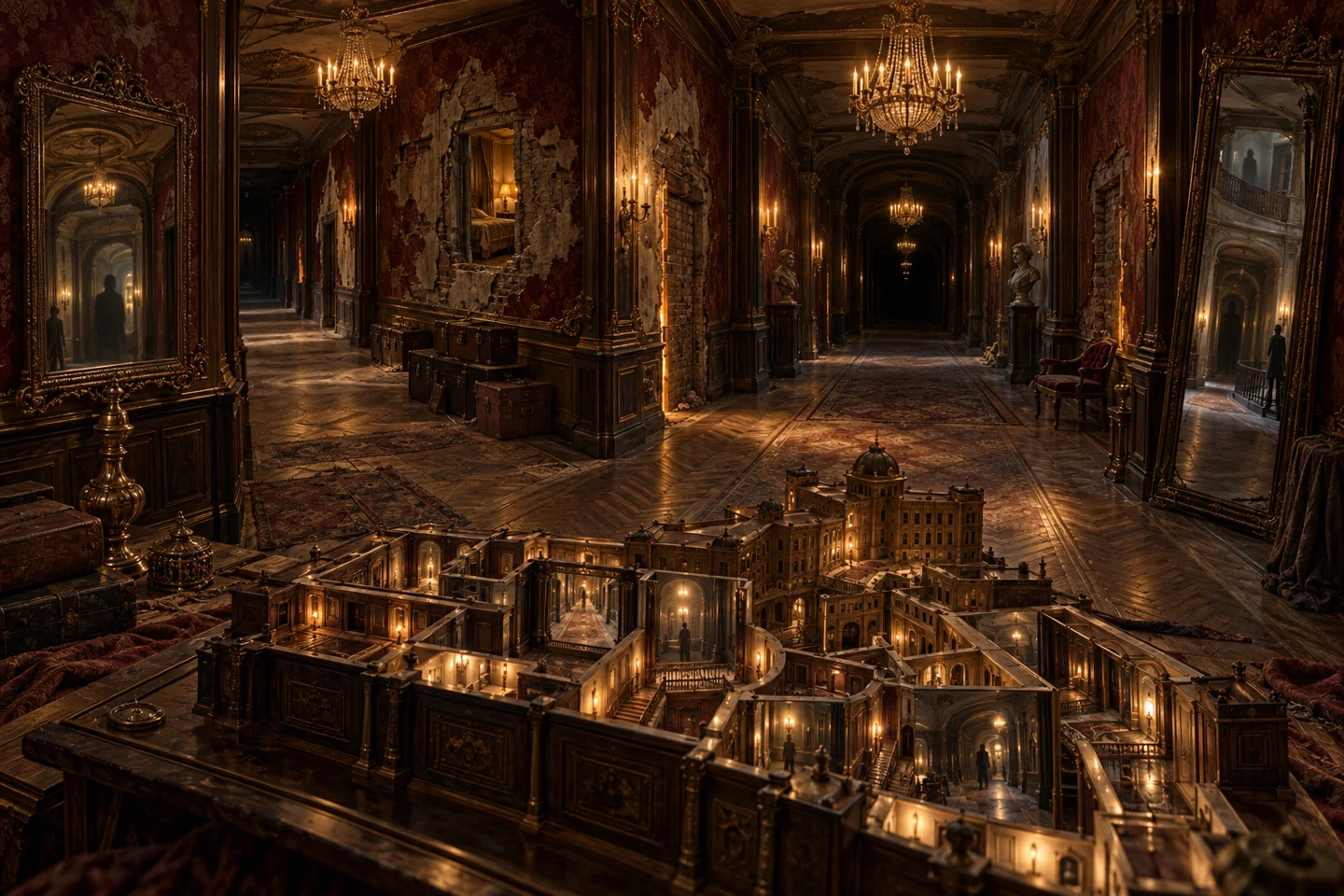
The breathing scale model
Miniature doors open a moment before their full-sized counterparts. A warm, unlabelled room expands while the rest of the model contracts.
05 / 18+ · Extreme architectural horror
An impossible floor above a condemned grand hotel. Oxblood velvet. Wet plaster. Doors that breathe.
Your lift opens on a floor absent from every plan. Behind freshly sealed walls, occupied rooms are still ringing for service. You have 55 fictional minutes before the hotel erases your room, with you inside it.
The story so far
The grand hotel closed after a renovation that no contractor remembers finishing. Tonight, its lift climbs one floor too far. Your survey cases are already waiting in a room furnished with belongings you have not yet lost. A scale model reconstructs the corridor each time you turn it. The mirrors show doors that are missing behind you. Someone inside the walls knocks back before you knock. Then a porter steps into a reflection, wearing the face from your own staff photograph. Every solved connection buys a route and wakes something else. The final guest register has six blank lines. They are filling themselves in.
“If the porter is facing you in the glass, do not ask what is standing behind you. Keep the stair in sight. Do not accept the room with your name on it.”
The shape of the adventure
Rotate an architectural model and redirect mirrored sightlines: every useful change opens one passage and gives the presence another way toward you.
The lift number disappears. Phone calls come from your own room before you reach it; a locked door repeats your last sentence in a teammate’s voice.
Corridors shorten as the model turns. Hand-shaped shadows press behind wallpaper, room numbers migrate, and the reflected porter moves closer whenever his sightline is broken.
The hotel starts removing your route from the plans. Reconstruct the missing stair under a collapsing fictional countdown, choose which reflection to trust, and leave before the last wall closes.
The tools of this world
A spoiler-light field guide. These are designed story objects, not real venue photographs.
Miniature doors open a moment before their full-sized counterparts. A warm, unlabelled room expands while the rest of the model contracts.
Each mirror reveals a different version of the corridor. One contains the porter; another shows the service stair only while someone watches it.
Names cross themselves out. Compare the overwritten entries and floor sketches to distinguish earlier victims’ warnings from the hotel’s invitations.
More than finding a code
A sustained, adult nightmare built around spatial deduction, unreliable reflections and escalating pursuit. Every mechanical success changes the architecture and reveals a more immediate threat.
Overlay survey fragments, rotate model wings and identify which corridor exists in the mirror but not on the plan. Wrong alignments advance the fictional renovation.
A teammate tracks the porter’s reflected position while another controls the model. Keeping the correct passage visible delays the presence without requiring physical restraint or unsafe movement.
The hotel offers a comfortable room marked with your name. Prove which doorway belongs to the original service stair before choosing the final route.
One surveyor keeps the model aligned, one reads the contradictory plans, and one watches the reflections. Communicate calmly while false voices, moving doorways and approaching silhouettes try to split your attention. Everyone stays together; nobody must run or be separated to progress.
Enable JavaScript to try this room’s short, untimed web task. The full story above is available without JavaScript.
Adults who deliberately choose very high tension, oppressive supernatural horror and difficult collaborative deduction. This is unsuitable for children or anyone seeking a gentle mystery.
The floor wants you to hurry. Verify a sightline together before trusting a doorway. In the web miniature, time changes only when you choose an action.
The proposed attraction uses oppressive corridors, moving-wall illusions, reflected figures and sudden appearances. Actual safety and accessibility are unverified. A real operator would need freely accessible emergency exits, an immediate stop signal and a no-contact, no-forced-running policy. The website remains freely navigable; its optional preview has pause, exit, reset and animation-off controls.
Read the practical notes →